Where Did the Puddle Go? A Simple Science Activity for Ages 4–6
A puddle can turn an ordinary walk into a question: “Where did the water go?” For a child aged 4–6, that small change is a useful place to begin a conversation about the world.
You do not need a long lesson. Start with a picture, listen to your child’s idea, and look for something you can compare together. Here is one way to use the puddle pages from Little Science Mysteries: Read, Wonder & Color Together.
Why does a puddle get smaller?
Some liquid water changes into water vapor and moves into the air. This is called evaporation. Water does not have to boil for evaporation to happen. Outdoors, some puddle water can also soak into the ground, so evaporation is not always the only reason a puddle shrinks.
For a young child, you might begin with: “Some of the water goes into the air. We cannot see that water vapor.” Save the longer explanation for a follow-up question.
1. Read the short story together
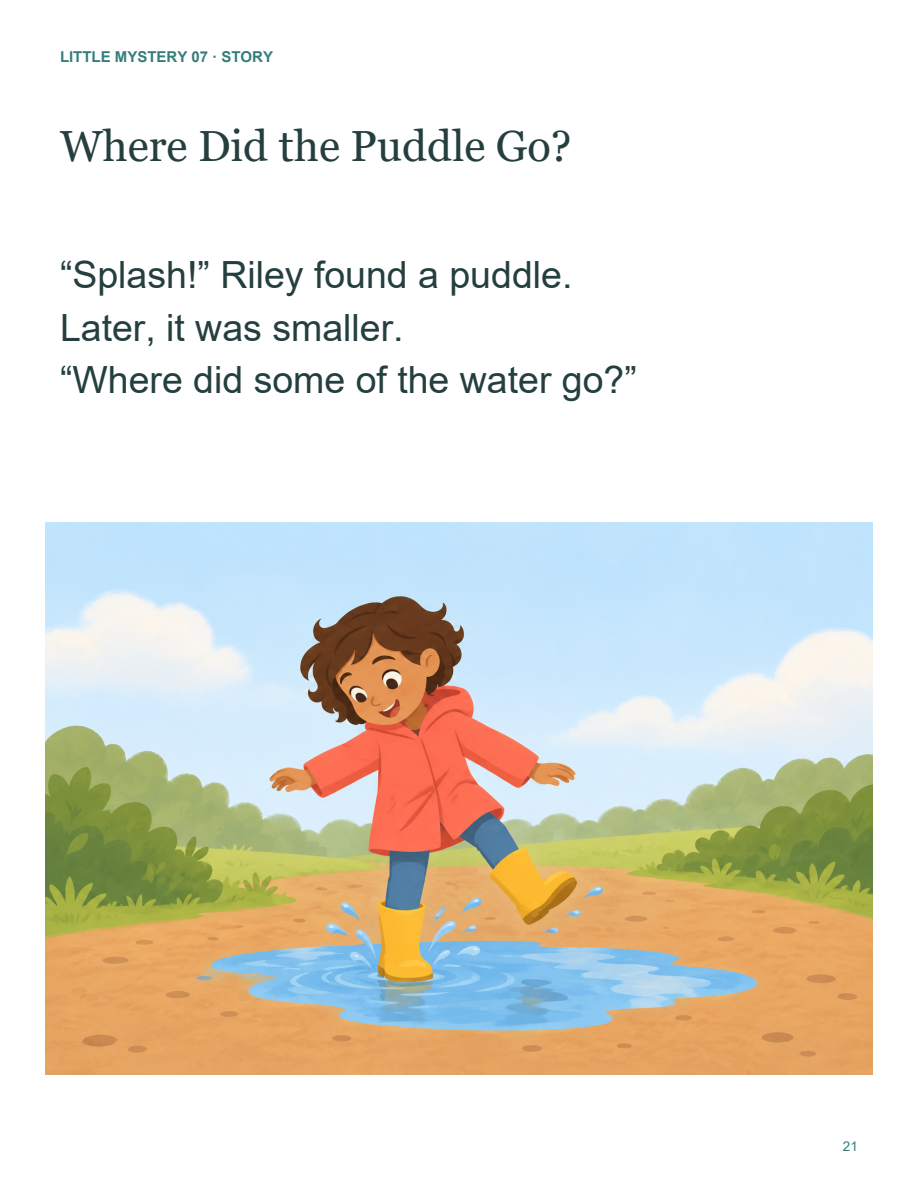
In the story, Riley finds a puddle. Later, it is smaller. Read the page aloud and pause before explaining the change. Ask, “What do you think happened?” Your child can answer with words, point to the picture, or show you with their hands.
You do not need to correct every guess immediately. Listen first, then return to the picture together. The question gives you something specific to notice.
2. Compare “before” and “later”
The next sample page shows two pictures of the puddle. Try these prompts:
- Which puddle looks bigger?
- What changed between the pictures?
- What stayed the same?
Let your child point before asking for an explanation. If they want to talk more, introduce the word “evaporation.” If they are ready to move on, the comparison can be enough for today.
3. Finish with a little coloring
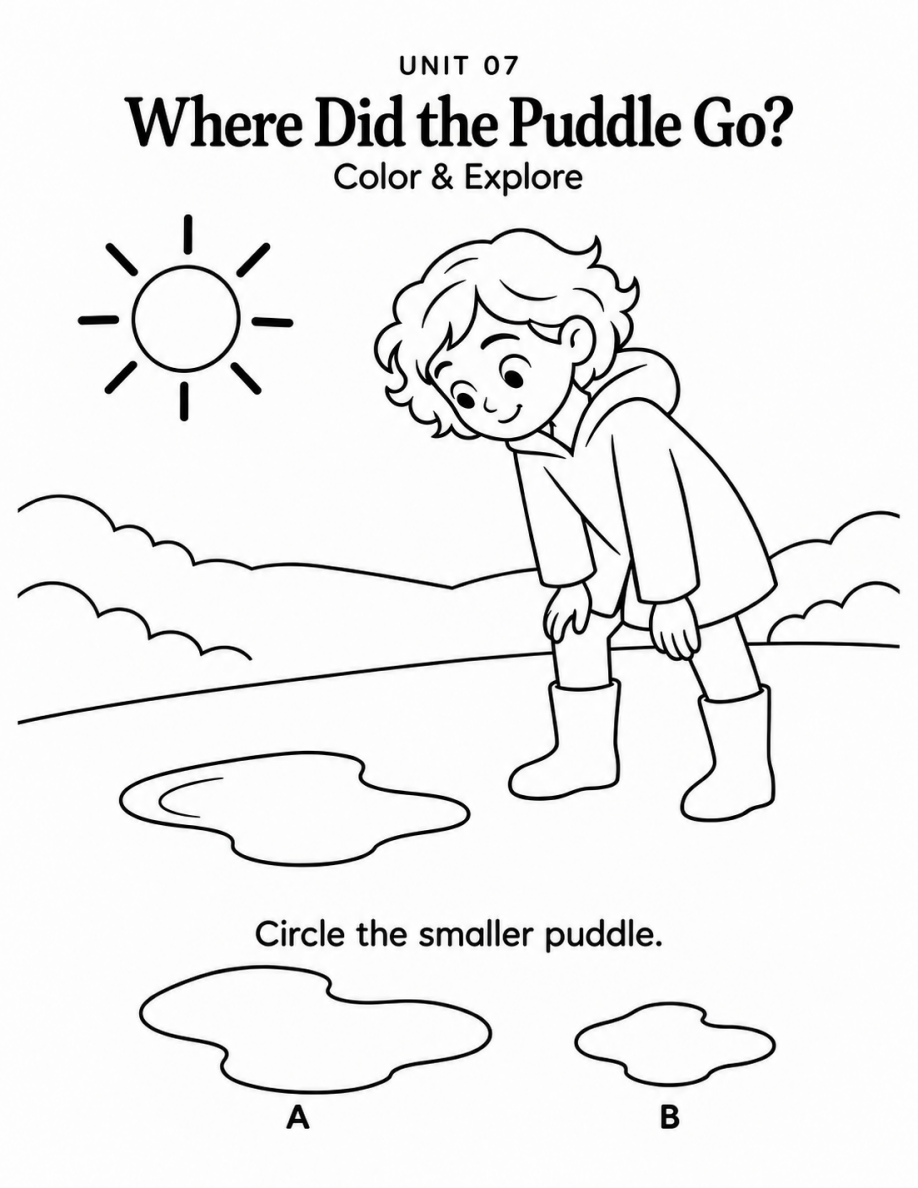
Print the coloring page, bring out crayons, and let your child choose Riley’s colors. The small comparison at the bottom offers another chance to find the smaller puddle. There is no need to turn coloring into a quiz: you can simply sit together and talk about the picture.
An optional follow-up on your next walk
If you pass a puddle on a safe path, notice its shape together. If you return later, look for a change. Weather and the ground affect what happens, so you do not need to promise that it will disappear by a particular time. This is an optional companion idea, rather than an additional worksheet included in the PDF.
Preview the pages before you buy
Little Science Mysteries is a 42-page English printable activity PDF for ages 4–6 to use with a grown-up. It combines short stories, picture activities, and coloring across ten everyday discoveries. The pages are US Letter size. This is a digital PDF to print at home; no physical book is shipped.
The complete PDF costs $6.99 USD. You can view six actual sample pages on the product page, including the puddle story, comparison, and coloring activity.
See the six-page preview and explore Little Science Mysteries →
Science reference: USGS Water Science School: Evaporation and the Water Cycle. Book pages and illustrations: RetroXLabs BOOKS.

Comments
Post a Comment